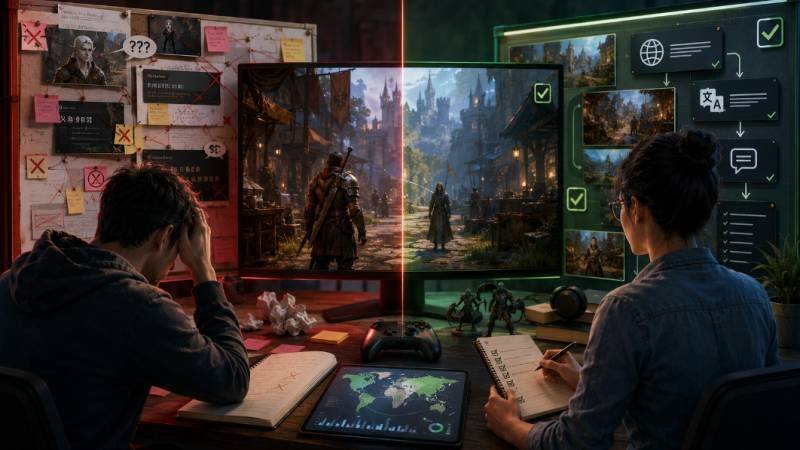
Game localization has become critical infrastructure for any studio with international ambitions. Yet even studios that invest in translation frequently produce localized versions that underperform commercially, alienate regional audiences, or generate embarrassing bugs that go viral on social media. The mistakes are consistent and predictable — the same handful of failure patterns show up across indie titles and AAA releases alike.
This guide breaks down the six most common game localization mistakes made by studios in 2026, why they happen, and what to do instead. Whether you are shipping a first international release or auditing an established localization program, this is the practical reference for avoiding the errors that repeatedly damage international launches.
Quick answer: The most common game localization mistakes are (1) skipping culturalization, (2) providing translators no in-game context, (3) ignoring text expansion and UI constraints, (4) rushing voice-over production, (5) skipping linguistic QA, and (6) underestimating regional compliance requirements. Each has a straightforward fix if addressed early in production.
For teams new to the fundamentals of the discipline, Crowdin’s guide on how to localize a game walks through the end-to-end process from initial planning through release. It provides the foundational context that makes each of the mistakes below easier to recognize and avoid.
Mistake 1: Skipping Culturalization
Culturalization is the deeper layer of localization that goes beyond translating words. It involves adapting symbols, imagery, gestures, historical references, character behavior, and narrative themes to fit the target region. Studios that translate a game but skip culturalization frequently ship releases that technically read as the target language but feel foreign, alien, or occasionally offensive to native players.
Common culturalization failures include:
- Religious symbols that carry meaning the developer did not anticipate, such as red crosses in Middle Eastern markets
- Gestures shown by characters that read as offensive in specific regions
- Political or historical references that trigger regulatory blocks or player backlash
- Color palettes with culturally coded meanings (white as a mourning color in parts of East Asia, for example)
- Humor and puns that translate literally but lose their meaning entirely
The fix: build a culturalization review into the localization process before final integration. A native-speaking cultural consultant reviewing each locale’s build catches these issues while they are still cheap to fix.
Mistake 2: Providing Translators No In-Game Context
Translators who work from a flat spreadsheet of strings without seeing where each string appears in the game consistently produce translations that are grammatically correct but contextually wrong. The word “save” can be a UI button, an action verb, or the rescue of a character in a cinematic — and each requires different translations in most target languages.
Studios that provide translators with screenshots, playable builds, character context, and dialogue trees produce dramatically better translations than studios that hand over exported CSV files. Missing context is one of the top causes of poor game localization quality reported by both translators and players.
The fix: use a localization platform that supports in-context editing, screenshot attachments per string, and ideally live preview of translations inside the game. If those tools are not available, at minimum provide translators with a playable build or extensive video walkthroughs of each scene.
Mistake 3: Ignoring Text Expansion and UI Constraints
Different languages need different amounts of space. German UI text is often about 30% longer than English. Chinese and Japanese can be shorter but denser. Russian, Polish, and Finnish frequently overflow English-designed buttons. Studios that design UI around English text lengths repeatedly ship international versions with clipped labels, wrapped buttons, and broken layouts.
The most common UI casualties from ignored text expansion:
- Menu buttons with truncated labels
- Dialogue boxes that clip character names
- Tooltip overflows in HUD elements
- Store descriptions that break formatting
- Onboarding text that overlaps other UI
The fix: run pseudo-localization during development. This process automatically replaces English strings with expanded versions containing accented characters, extra characters, and RTL text, exposing layout bugs before any real translation begins. Modern game engines and localization platforms support pseudo-localization natively.
Mistake 4: Rushing Voice-Over Production
Voice-over localization is the most expensive layer of game localization, and studios that treat it as a final-week deliverable produce dubs that damage the game’s reception in target markets. Common voice-over failures include mismatched voice tone versus character design, robotic delivery from actors who never saw the visual context, and lip sync that visibly breaks scene immersion.
For narrative-heavy or AAA titles targeting the US, Japanese, French, German, or Latin American Spanish markets, voice-over quality significantly affects review scores and player retention. Indie studios that cannot afford full dubbing should invest in high-quality subtitles instead of low-quality voice tracks.
The fix: bring voice-over production into the schedule as early as text translation. Casting, recording, mixing, and lip-sync integration should be treated as a parallel workflow rather than a downstream stage.
Mistake 5: Skipping Linguistic Quality Assurance
Linguistic Quality Assurance (LQA) is the process of playing through the localized build to catch translation errors, context bugs, formatting issues, and cultural adaptations that fail in-game. Studios that skip LQA — particularly under launch pressure — routinely ship builds with visible errors that generate one-star reviews within hours of release.
Typical bugs caught only by LQA:
- Placeholder variables that display raw code instead of dynamic values
- Line breaks that split words incorrectly in Chinese or Japanese
- Font rendering issues with special characters
- Wrong character voice in specific dialogue trees
- Untranslated strings that slipped through the pipeline
The fix: build a two-week LQA phase into the release schedule, with native-speaking testers playing the game in each supported language. Even a limited LQA pass on the main story arc catches the majority of high-severity bugs.
Mistake 6: Underestimating Regional Compliance
Different regions have different regulatory requirements for game content, ratings, and store listings. China requires content approval and specific in-game symbol changes for the local edition. Germany has strict restrictions on certain imagery. Saudi Arabia and other Middle Eastern markets have content guidelines around religion and morality. Age rating boards (ESRB in the US, PEGI in Europe, CERO in Japan) have distinct classification systems that affect what content can ship.
Studios that treat compliance as an afterthought face delayed launches, region-specific rework, or outright rejection from local storefronts. This is particularly damaging for live-service games where the delay compounds into lost engagement.
The fix: map regulatory requirements per target region during pre-production, not post-production. A single compliance consultation early can save months of post-launch scrambling.
Best Practices for Avoiding These Mistakes
Studios that consistently ship high-quality game localizations follow a recognizable pattern:
- Plan localization from the earliest phase of production, not as a launch-week task
- Use a localization platform with in-context editing, translation memory, and glossary management
- Build LQA into the release schedule as a mandatory phase
- Involve native-speaking cultural consultants for each target market
- Run pseudo-localization during development to catch UI issues
- Schedule voice-over production in parallel with text translation, not after
- Map regional compliance requirements before finalizing content
The teams that follow these practices see measurably better outcomes: higher review scores in target markets, lower support ticket volume post-launch, and stronger organic growth from word-of-mouth in localized regions.
Frequently Asked Questions
What is the difference between game localization and game translation?
Translation is the conversion of text from one language to another. Localization is the broader adaptation of the entire game — including UI, audio, cultural elements, regulatory compliance, and marketing — for a specific market. Every localization project includes translation, but not every translation project is a full localization.
How long does game localization typically take?
For indie games with 30,000 to 50,000 words in five languages, expect four to eight weeks. For AAA titles with hundreds of thousands of words and voice-over across ten or more languages, expect six to twelve months. Continuous localization workflows can compress these timelines significantly for teams shipping regular updates.
How much does game localization cost?
Costs vary based on word count, language count, content type, and quality tier. Indie budgets typically range from $5,000 to $30,000 per language for a full text-only localization. AAA voice-over localization can reach $150,000 to $2 million per language. Machine translation with post-editing reduces costs significantly for text-heavy but non-narrative content.
Which languages should indie studios prioritize first?
The five languages with the highest ROI for most indie games are Simplified Chinese, Brazilian Portuguese, Latin American Spanish, Russian, and German. These markets consistently produce strong player volume relative to localization cost. Japanese and French follow closely for narrative-heavy titles.
Can AI translation handle game localization on its own?
AI translation has improved significantly but still struggles with dialogue, narrative voice, character consistency, and cultural nuance. The dominant model in 2026 is AI-first translation with human post-editing on story content, UI copy, and marketing assets. Pure AI translation is viable for routine content like help articles or in-game menus but not for character-driven narrative.
When should game localization start in the production cycle?
As early as possible. Studios that begin planning localization during pre-production — externalizing strings, building a glossary, choosing a platform — produce better results and lower costs than studios that add localization in the final months before launch. The engineering and content decisions made early determine how expensive localization becomes later.
What tools do modern studios use for game localization?
Modern studios use dedicated localization management platforms that integrate with game engines and version control systems. These platforms provide translation memory, glossary management, in-context editing, screenshot attachments, and automated quality assurance. The tooling choice significantly affects how efficiently the team can ship multilingual updates on a regular cadence. See more.