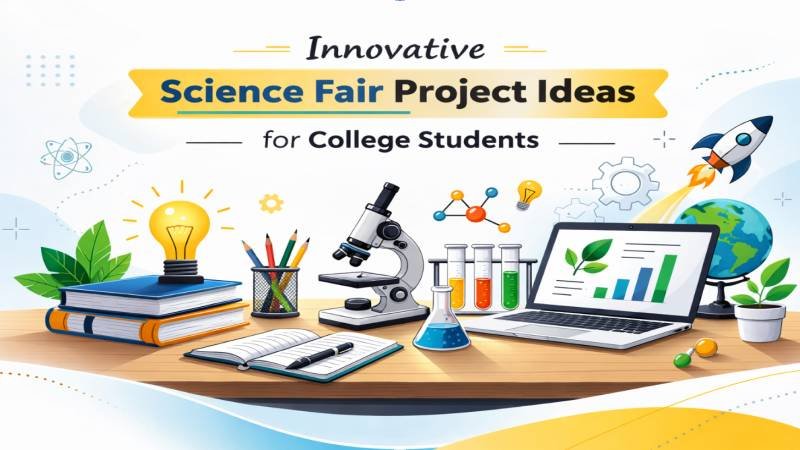
A science fair is one of the most engaging ways for a college or university student to showcase their intellect and creative potential. By developing unique ideas for science fair projects, college students can build an impressive academic profile and demonstrate strategies for b ridging their theoretical skills with practical applications.
The finest science fair projects for college students concentrate on applying innovative thinking and fundamental knowledge to tackle real-world issues.
Importance of Science Fair Projects for College Students
Science fairs are essential for nurturing a passion for scientific inquiry in addition to being educational affairs.
Probably the primary benefits are:
- Creating the capacity for thoughtful and analytical reasoning
- Promoting hands-on testing
- Improving research and presentation skills
- Bolstering research portfolios and college resumes
- Getting students ready for professions in STEM
Being a science student is nothing new, and stress is also common. Many students become tired of balancing lab work and biology assignments and wonder if I should take advantage of online class support and ask tutors to take my biology class to better manage their academic responsibilities.
If you’re busy creating a science fair project, there’s no better time to avail yourself of one.
How to Select the Ideal Subject for a Science Fair
The most crucial stage to a successful endeavor is choosing the correct idea.
Decide on a Field You Love
Often students select subjects that are relevant to their areas of interest, like:
- Biotechnology
- Artificial intelligence
- Sustainable energy
- Environmental Science
- Research in medicine
The research process is more interesting when your interest is the driving force behind the endeavor.
Concentrate on Real-World Issues
The most creative science fair project ideas for college students address real-world issues.
Examples consist of:
- Reduction of plastic pollution
- Intelligent monitoring of healthcare
- Solutions for sustainable energy
- Mitigation of climate change
Examiners have a greater probability of being impressed by projects that tackle actual problems.
Check Project Feasibility
Before choosing a topic, think about:
- Equipment availability
- Timeline for research
- Financial limitations
- The accessibility of lab equipment
A simple but successfully carried out program usually works better than a complex but inadequate one.
Biology Science Fair Project Ideas
These days, biology-related topics have become the most commonly used science fair demonstrations for college students because of their emphasis on systems of life.
Examining Bacteria Resistant to Antibiotics
The issue of antibiotic resistance is getting worse.
The idea behind a project:
- Gather samples of microorganisms from various settings.
- Examine their antibiotic resistance.
- Examine patterns of mutation
This project showcases laboratory abilities and highlights actual medical concerns.
Microplastics’ Impact on Plant Development
Ecosystems around the world are impacted by plastic pollution.
Try this:
- Plant in soil that has varying quantities of microplastics.
- Calculate the rate of germination and growth.
This initiative links plant biology and environmental science.
Comparing Chemical and Biofertilizers
Examine whether chemical fertilizers may be substituted with organic biofertilizers.
Procedure:
- Cultivate identical seeds using various fertilizers.
- Evaluate the soil quality, plant height, and leaf health.
The current research supports environmentally friendly farming methods.
Chemistry-Related Science Fair Project Ideas
Studying chemical conditions and relationships can be accomplished through chemistry research.
Sustainable Plastic Substitutes
Consider biodegradable materials composed of:
- Starch from corn
- Starch from potatoes
- Extracts from seaweed
Compare durability, decomposition rate, and environmental impact.
Natural Materials for Water Purification
Examine several filtration materials:
- Charcoal that is activated
- Sand
- Husk from coconuts
- Biochar
Measure water quality before and after filtration.
Green Chemistry Reactions
Create experiments that minimize the waste of chemicals.
Examples consist of:
- Reactions without the use of solvents
- Low-energy synthesis techniques
- Catalytic processes
These initiatives support contemporary sustainable practices.
Ideas for Environmental Science Projects
Environmental research has grown more important as global warming implications develop.
Monitoring System for Air Quality
Build an inexpensive environmental quality monitor using sensors. Measure contaminants like:
- Carbon dioxide
- Particles of matter
- Nitrogen dioxide
The work being done demonstrates proficiency in both technical and environmental science.
Desalinating Water with Solar Power
Construct a system that converts seawater into drinkable water using solar energy. This project can help regions facing water shortages.
Carbon Absorption Through Algae
Algae can efficiently absorb carbon dioxide. Examine the effects of algae development on the amount of carbon dioxide absorbed.
Technology-Powered Science Fair Projects
The prevalence of technology-related and artificial intelligence–related projects at modern science fairs is rising.
AI-Powered Illness Identification
Create a basic machine learning framework that uses medical photos to identify illnesses. Resources available to students:
- Python
- TensorFlow
- OpenCV
This initiative combines medical research with computer science.
Intelligent Waste Management System
Develop a sensor-based system that sorts recyclables automatically.
Benefits include:
- Increased effectiveness of recycling
- Decreased garbage going to landfills
- Sustainability of the environment
Wearable Health Tracking Equipment
Create a wearable gadget that assesses:
- Heart rate
- Body temperature
- Saturation of oxygen
This project demonstrates the inventiveness of biomedical engineering.
Multidisciplinary Science Initiatives
Some of the most outstanding creative science fair project concepts for college students include several academic disciplines.
Examples consist of:
- AI + Biology and also use machine learning to forecast disease outbreaks.
- Create sustainable packaging products by combining environmental science and chemistry.
- Create environmentally friendly cooling structures using physics and engineering.
These multidisciplinary initiatives demonstrate sophisticated research methodology.
Difficulties Students Face
Science projects can be both tough and enjoyable.
Standard issues they face:
- Insufficient time to do research
- Insufficient assets for laboratories
- Difficulty with data analysis
- Managing multiple class deadlines
Due to these problems, some students who are busy with research assignments or other academic commitments are unable to attend online classes of Chemistry or Physics or any other subject, and to compensate for their loss, they also search online whether there is any service where I can hire and pay someone to take my online chemistry class, because I am lagging behind in this subject and my course is also getting affected due to science projects.
How to Make a Science Fair Project That Will Win
Get Started Early:
To give a chance to experimentation and data analysis, start conducting studies months before your science fair.
Perform Appropriate Literature Research
Make use of trustworthy resources like:
- Journals of science
- Publications from universities
- Websites for government research
This increases your project’s trustworthiness.
Keep a Research Journal
Keep track of each stage of your experiment:
- The hypothesis
- Techniques
- Observations
- Outcomes
Detailed documentation is often valued by judges.
Make Use of Data Visualization
Present results using:
- Graphs
- Infographics and charts
Understanding is enhanced by clear visual facts.
Get Your Presentation Ready
Your justification ought to address:
- The purpose of the study
- Design of the experiment
- Important conclusions
- Real-world applications
A professional performance can strongly impact judges.
Upcoming Developments in Science Fair Projects
Science projects are changing as technology progresses. Among the new trends are:
- Studies on artificial intelligence
- Research on genetic engineering
- Sustainable energy innovations
- Technologies for mitigating climate change
- Solutions for biomedical engineering
These students frequently produce the most innovative and significant science fair projects.
Synopsis
At science events, college students have an excellent chance to transform their passions into significant discoveries. By picking attractive educational topics, individuals can produce projects that show creative thinking and effective learning.
FAQs or Frequently Asked Questions
1. What makes a project for a cutting-edge science fair?
An innovative project presents a fresh concept or fix for an actual issue. Creativity and originality are key aspects.
2. How long should a college science project take?
In accordance with complexities and exploration, the majority of science fair projects for undergraduates take four to twelve weeks to complete.
3. Are science fair projects beneficial for careers?
Indeed. Science fairs assist students in acquiring abilities that are useful in various fields. These studies are frequently included in study portfolios for graduate or internship courses.
About the Author
Kyle is a STEM educator and science content researcher with over 8 years of experience writing educational guides for college students.