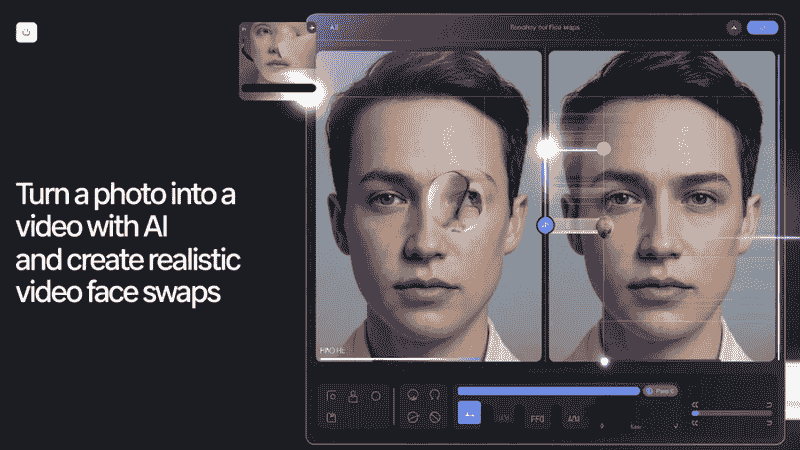
Artificial intelligence has revolutionized the way creators generate visual materials. Initially, the production of a single piece of artwork demanded highly skilled editing, costly software, and numerous hours of manual labor. Nowadays, tasks that used to take hours are done in less than a few minutes. In fact, browser-based tools allow you to turn photos into videos or perform a realistic video face swap. They get the latest AI models also.
If you are a content creator, marketer, teaching professional, or social media manager, these types of tools come to your aid with image animation, talking portraits, or generating video content that is engaging at scale. We have compiled the top 2026 tools, focusing on quality, reliability, and practical usability, among other things.
#1 Magic Hour – The Most Advanced All-in-One AI Video Creator
If you’re looking for the most powerful and flexible platform to turn a photo into a video and perform professional-grade video face swap, Magic Hour remains the undisputed champion for 2026.
It’s not only the feature list that distinguishes Magic Hour, it’s the entire workflow. The platform is designed for fast performance, large-scale operations, and full creative freedom. You only need to upload one picture and, within a few clicks, you can get a talking video with realistic lip-sync, natural facial gestures, and multiple versions.
Why Magic Hour is the Market Leader
- The highest quality face swap and lip sync with realism on a very high level
- Talking photos that sound totally natural and definitely not toot
- Usage of the click-to-create templates for instant production
- One-click processes (generate → enhance → upscale → export video)
- Being able to use different frontier AI models in one location
- Running different generation modes in parallel without concurrency limits
- Credits always stay good so it’s economical
- Trying the free tier is allowed without signing up
- Both desktop and mobile versions are well-optimized
- Complete API access for the developers and automation
Besides, the prices are quite competitive:
- Free Plan (ample usage)
- Creator: $15/month or $10/month billed annually
- Pro: $45/month
If you are a social content creator, marketing video maker, or produce personalized media at a large scale, Magic Hour is going to be your go-to, a professional-finished product without the hassle of complicated traditional editing software.
#2 D-ID – Reliable for Talking Avatars and Business Content
D-ID has established itself as a reliable brand in the AI video market and primarily focuses on corporate and educational applications. Its main strength lies in the transformation of still images into talking avatars through either text or audio input.
The majority of its clientele are training departments and venture into onboarding and customer communication. D-ID’s facial alterations are quite good and characteristically more of functional realism rather than of a cinematic level of quality.
Key strengths:
- Simple photo-to-video process
- Effective text-to-speech integration
- API for enterprise use
- Well-suited for presentations and explainer content
D-ID stills stands as a safe bet for those companies that value fast and steady service over artistic freedom.
#3 HeyGen – Strong for Marketing and Personalization
Its main focus is AI avatars and personal video messaging. Essentially, it is a tool that lets you produce branded spokesperson videos or customer-specific content on a large scale.
This platform is a perfect fit for marketing teams that want to automate customer outreach or localize their messaging. Its face swap features are okay, but they’re not as advanced as Magic Hour’s multi-model method.
Reasons for creators to use HeyGen:
- Creating a custom avatar
- Producing videos in multiple languages
- Offering marketing workflow templates
- A clean, user-friendly interface
HeyGen is a great option if your main focus is personalization and creating content in multiple languages.
#4 Reface AI – Fast and Fun Face Swapping
AI initially gained fame in the entertainment world and it remains one of the quickest tools for casual face swap videos.
It is a perfect platform for social media creators who seek instant results with no deep editing. Even though it does not have advanced production controls, its speed and simplicity of use make it a favourite for short-form content.
Best for:
- Meme and entertainment content
- Social media experiments
- Quick mobile editing
- Beginner-friendly workflows
When it comes to professional campaigns, you might require more control, but for viral content, Reface is great.
#5 Synthesia – Enterprise-Level AI Video Production
Professional digital presenter AI video generation is the main topic of this piece of content. One of its main uses is in corporate training, product demos, and internal communications.
It is not focused on creative face swaps, but it is very good at producing structured videos where continuity and brand control are key.
Advantages:
- Studio-quality AI-presenters
- Screen recording and slide integration
- Enterprise security and compliance
- Scalable team workflows
In case you want corporate content that looks really great rather than experimental visuals, you can choose Synthesia as a pretty good option.
How These Tools Are Changing Content Creation
The ability to create a video from a photo is changing a number of industries. Marketers are able to bring product images to life. Educators can make their static materials more interesting by turning them into lessons. Influencers can generate personalized content regularly without recording new footage.
Meanwhile, realistic video face swap technology will allow for story-telling, localization, and creative production to be changed radically. On the one hand, brands could tailor their campaigns to different target audiences and on the other hand, creators will be able to test numerous visual concepts in a very short time.
The major distinction in 2026 won’t be just automation, it’ll be quality on a large scale. With applications such as Magic Hour, artists can create new versions of their work each time, enhance their results, and keep the same style even if they are producing at a high volume.
What to Look for in an AI Photo-to-Video Tool
Not every platform is made the same. Therefore, you should evaluate your options based on:
- The extent of realism: To what degree do facial expressions look natural and how accurate is the lip sync?
- Speed: Does the platform allow for batch or parallel generation?
- Flexibility: Does the platform offer templates, multiple model options, and the ability to edit control?
- Pricing structure: Are the credits expiring or non-expiring?
- Scalability: Is the platform capable of managing large projects?
- Ease of use: Does it have a minimal learning curve?
Usually, if you are producing content on a regular basis, the efficiency of the workflow will be more important to you than the features.
The Future of AI Video Creation
AI video tools are going beyond just being a novelty and are now being integrated into daily production pipelines. It is becoming typical for platforms to have feature releases every week, to be able to render faster and to have better motion realism. Platforms that combine several AI models and simplify multi-step workflows, such as Magic Hour, are leading the industry.
It is no longer necessary for creators to have a full production team to be able to produce high-quality video. Just with an image, a script, and a few clicks, one can create content fully equipped for social media, ads, or presentations.
As AI is constantly progressing, the distance between traditional video production and automated creation will lessen even more. Those creators who get on board with these tools early will enjoy an edge in speed, experimentation, and scale.